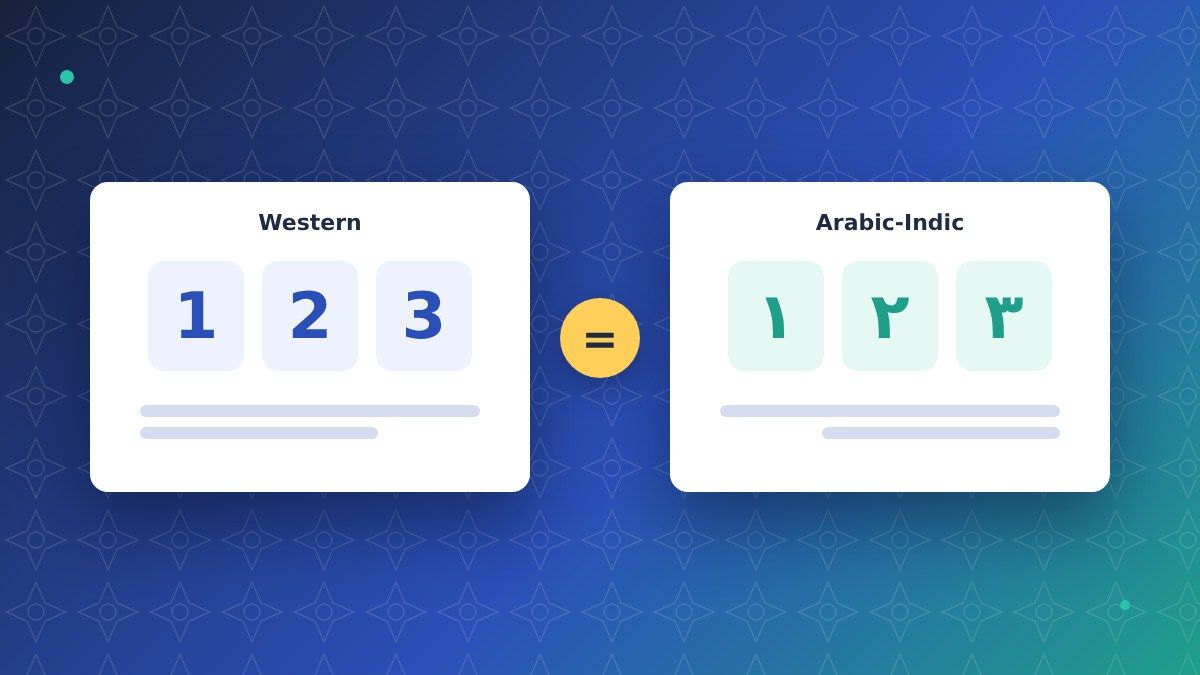
Few things confuse foreign companies more than numbers in Arabic. The digits most of the world calls "Arabic numerals" (0, 1, 2, 3) are not the ones you see on many Arabic packages, contracts and websites (٠، ١، ٢، ٣). Both are correct, both are Arabic, and choosing the wrong one, or mixing them, makes a text look careless. Here is how to decide.
Two digit systems, one language
Western digits (0-9) developed in North Africa and spread to Europe. Arabic-Indic digits (٠-٩) are used in the Middle East. In Arabic texts both systems are read the same way: numbers are written from left to right, even inside a right-to-left sentence. Only the shape of the digits changes.
Which countries use which
- Maghreb (Morocco, Algeria, Tunisia, Libya): mostly Western digits, in daily life and in official documents.
- Gulf countries (Saudi Arabia, UAE, Qatar, Kuwait, Oman, Bahrain): Arabic-Indic digits are traditional and common in official texts; Western digits are frequent in business, prices and technology.
- Egypt, the Levant and Iraq: Arabic-Indic digits are widespread in print and signage, Western digits in digital and commercial contexts.
- Pan-Arab content for several markets: Western digits are the safest neutral choice, unless the client has a style guide.
There is no single rule for a whole country: a Saudi ministry, a Saudi e-commerce site and a Saudi supermarket label may all make different choices. When in doubt, follow the client's existing materials or the local distributor's advice.
Prices, dates and phone numbers
Prices must match exactly what the customer pays and what appears on receipts, so many companies keep Western digits for prices even in Arabic texts. Dates follow the same choice as the rest of the text; if the Hijri calendar is also used, say which calendar each date refers to. Phone numbers, codes and email addresses are better kept in Western digits, because customers copy them into phones and forms.
Tables, technical data and product codes
Technical manuals, data sheets and tables contain measurements, tolerances, part numbers and standards (for example ISO 9001). Product codes and standard numbers are never converted: they must match the label on the product and the original documentation. Measurements and values can follow the chosen digit system, but they must stay identical in every table and every language version.
The real mistake: mixing systems
The most common problem is not choosing the "wrong" system but using both in the same document: Western digits in the text and Arabic-Indic digits in the tables, or the opposite on the cover and in the footer. Automatic conversion in layout software can also change digits that should not change, such as model numbers. A final check of every number in the finished layout avoids this. See also the 7 most common Arabic DTP mistakes.
Checklist
- Decide the digit system for each market before translation starts
- Write the choice in the style guide or glossary
- Keep product codes, standards and model numbers unchanged
- Check prices against the source and against receipts or price lists
- Check that dates refer to the right calendar
- After layout, check every number again in the PDF
How we work
At Arabic Translators we agree the digit system with you at the start of each project, record it in your glossary and apply it consistently in the translation, in tables and in the final layout. Our Arabic DTP team checks every number in the finished files before delivery. Request a free quote.
FAQ
Are Western digits "wrong" in Arabic?
No. They are standard in the Maghreb and widely used in business across the Arab world. What matters is consistency and the expectations of your market.
Do Persian and Urdu use the same digits?
Not exactly. Persian and Urdu use Eastern Arabic-Indic digits, and some of them (4, 5 and 6) have different shapes from the Arabic ones. Arabic and Persian texts should not share the same font settings for digits.
Can you convert the digits in a document we already have?
Yes. We convert digits in Word, InDesign and other files, leaving product codes and standards unchanged, and we check the result page by page.