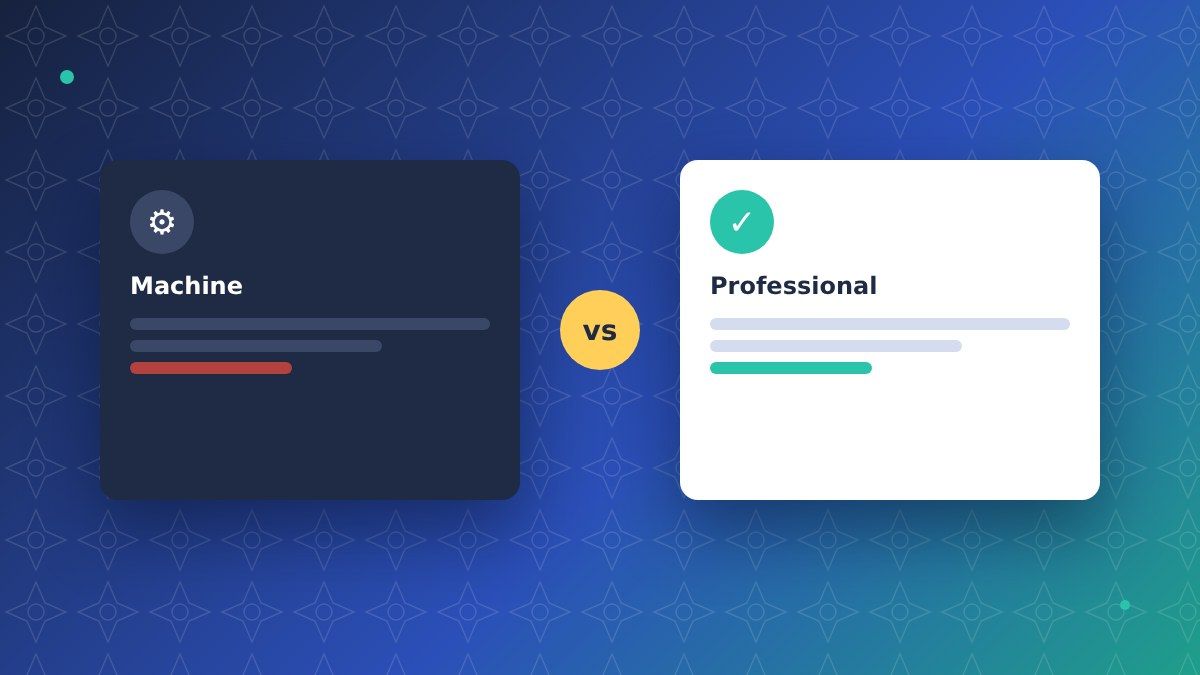
Machine translation has improved a lot, and for Arabic it can now produce fluent sentences in seconds. Fluent, however, does not mean correct. Here is when machine translation can be useful, when it is a risk, and what the middle way of post-editing really means.
When machine translation can be enough
- To understand the general meaning of an email or a document you received
- For internal notes that will not be published or signed
- To search large amounts of text for relevant passages
In these cases a reader who knows the context can tolerate some errors, and no customer, authority or court will rely on the text.
When you need a professional translator
- Contracts, certificates and documents with legal value
- Manuals, safety instructions and labels
- Marketing texts, websites and packaging that represent your brand
- Medical and pharmaceutical texts
- Anything that will be published, signed or submitted to an authority
Typical errors of machine translation into Arabic
Arabic is a rich language with complex grammar, and machine translation makes errors that are hard to see for a non-native reader: wrong gender or number agreement, mixed regional words in a Modern Standard Arabic text, terms translated literally instead of with the technical term used in the sector, names of people and products spelled in different ways, and numbers or units changed. The text reads well, so nobody notices until a customer or an authority does.
Confidentiality
Free online translators may store or reuse the texts you paste in. Contracts, personal data and unpublished product information should never be pasted into a public tool. A professional provider works under confidentiality agreements and controls who can access your files. See also 9 pitfalls in contract translation into Arabic.
Post-editing: the middle way
In machine translation post-editing (MTPE), a professional translator checks and corrects a machine draft. It can save time on repetitive, technical texts of good quality. It does not work well for creative, legal or poorly written source texts, where correcting a draft takes longer than translating. A good provider tells you honestly which texts are suitable.
How to decide
- Who will read the text, and what happens if it contains an error?
- Does the text have legal, safety or commercial value?
- Is it confidential?
- Will it be published or printed?
If the answer to any of these questions is important, use a professional translator, with or without a machine draft.
How we work
At Arabic Translators native Arabic translators translate from Italian, English, German and French. For suitable texts we also offer post-editing, always done by a professional translator and never as raw machine output. All files are handled confidentially. Read how much an Arabic translation costs or request a free quote.
FAQ
Is post-editing always cheaper?
Only for suitable texts. For short, creative or legal texts the saving is small or none, and we will tell you before you order.
Can you check a machine translation we already made?
Yes, but if the draft is poor, a new translation is often faster and more reliable. We look at a sample first and recommend the better option.
Do you use AI tools?
Only with your agreement and only in secure tools, always followed by a full review by a professional translator.