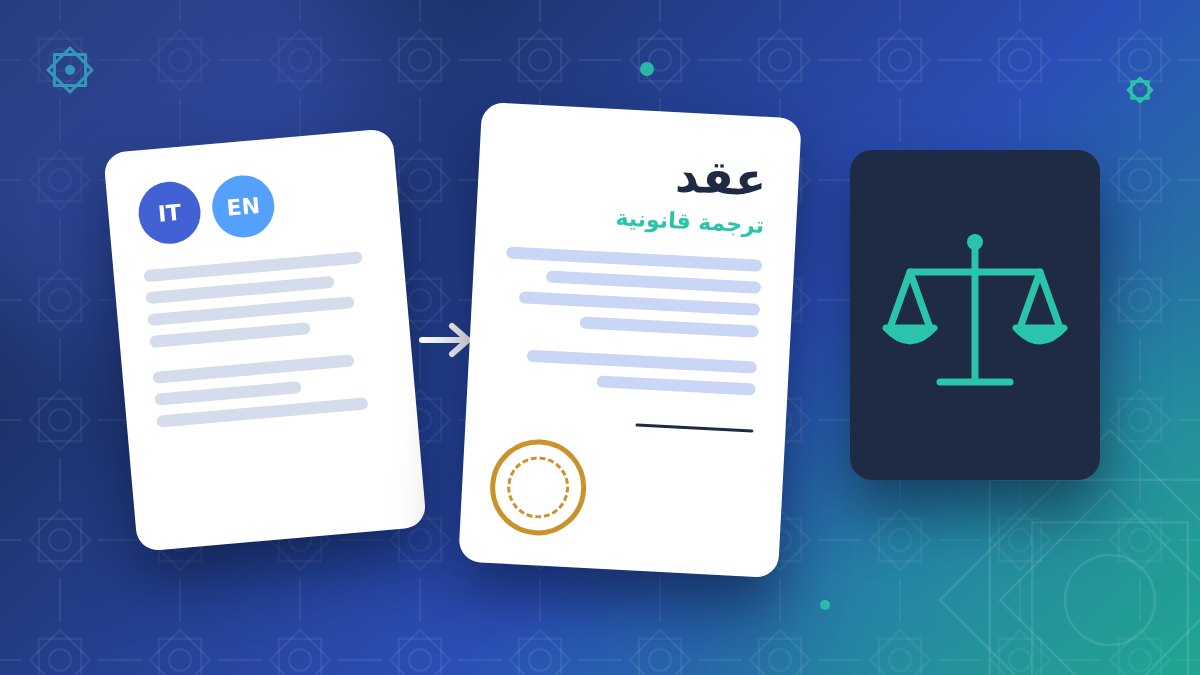
When a law firm or a notary's office needs a legal text in Arabic, the translation is part of the legal work: a wrong term in a power of attorney, a contract or a company deed can delay a transaction, a registration or a court case. This guide explains what makes legal translation from Italian and English into Arabic different, what to check before choosing a provider and how to prepare the documents so that the Arabic version is accurate and usable.
Why legal Arabic needs a specialist
Legal translation is not only a question of language. Each text belongs to a legal system, and the Arabic version must be understood by lawyers, notaries, judges or registries in another country.
- Many civil codes in the Arab world derive from the Egyptian Civil Code of 1948, which belongs to the civil law tradition, like the Italian one. Concepts such as contract, obligation or liability often have a recognised Arabic equivalent, but the details still differ from country to country.
- Other areas, such as family law and inheritance, follow rules that have no direct equivalent in Italian or English law, so terms must be chosen with care and sometimes explained.
- Legal vocabulary varies between regions. A power of attorney is usually توكيل in Egypt and وكالة in the Gulf countries, and the office of the notary also has different names. The translator must know where the document will be used.
- In some jurisdictions, such as the onshore courts of the United Arab Emirates, proceedings take place in Arabic, so the Arabic text is the one the court actually reads.
The documents law firms and notaries translate most often
- Commercial contracts, distribution and agency agreements, NDAs and general terms and conditions
- Powers of attorney and notarial deeds
- Articles of association, company registry extracts, board resolutions and certificates of good standing
- Court documents: writs, judgments, expert reports and evidence
- Inheritance documents, declarations and personal documents linked to a legal procedure
- Correspondence with Arab counterparts, authorities or local lawyers
How to choose a legal translation provider for Arabic
- Native Arabic translators with legal training or long experience with legal texts, working into their native language.
- A clear language pair: translating from Italian directly into Arabic avoids the loss of meaning that often happens when the text passes through English first.
- Revision by a second linguist, with special attention to names, numbers, dates and defined terms.
- Confidentiality: a non-disclosure agreement if needed, secure file transfer, data processed in line with the GDPR and no confidential text pasted into free machine translation tools.
- Terminology management: a glossary of the firm's and the client's terms, so that the same concept is always translated in the same way across all documents.
- The ability to deliver the Arabic text in the right format, including bilingual two-column contracts and correct right-to-left layout.
- A clear quote with price and delivery date before the work starts. Read more about what affects the price of an Arabic translation.
Translations for official use abroad
If the Arabic translation must be filed with a court, a registry, an embassy or a notary in an Arab country, check the required form before you order it. Depending on the country and the document, the authority may accept a simple translation or require a sworn translation, an apostille or consular legalisation. Some Arab countries apply the Apostille Convention, others still require legalisation through the consulate. The receiving authority or your local correspondent lawyer can confirm the exact procedure.
How to prepare the documents
- Send the final, signed version or the final draft that will be signed, not an intermediate version.
- Include annexes, stamps, handwritten notes and marginal notes: in legal documents they are part of the text.
- Tell us the country where the document will be used and its purpose, for example a company registration, a court case or a sale.
- Write all names of people and companies as they appear in passports and registry documents, and add any existing Arabic spelling.
- Share previous translations and glossaries from the same client or matter.
How we work
At Arabic Translators, native Arabic translators with legal experience translate contracts, deeds, powers of attorney and court documents from Italian and English into Arabic, and from Arabic into Italian and English. A second linguist checks terminology, names, numbers and dates, and we can deliver bilingual layouts ready for signature. Learn more about our legal translation into Arabic service or request a free quote.
FAQ
Do you translate directly from Italian into Arabic?
Yes. Our translators work directly from Italian into Arabic, without passing through English, so the legal meaning of the Italian text is not filtered through a third language.
Which Arabic do you use for legal texts?
Modern Standard Arabic, the written standard used in legislation, contracts and courts in all Arab countries, with the terminology of the country where the document will be used.
How do you protect confidential documents?
Files are exchanged through secure channels, processed only by the people working on the project and never uploaded to free online translation tools. On request we sign a non-disclosure agreement.
Can you translate a contract into a two-column bilingual version?
Yes. We can deliver the Arabic text next to the original, with matching clause numbers, ready to be signed by both parties.